Worth knowing
What sector classifications often fail to show
1. Companies rarely belong to "just" one sector
Many listed companies are broadly diversified in operational terms. However, they are usually formally assigned to a sector based on their dominant contribution to sales or earnings. Marginal activities, future areas or strategic transition phases are often underrepresented in traditional classifications, although they can be relevant for the long-term classification of a business model.
2. Classifications are snapshots - not forecasts
Industry classifications reflect the current or recently observed situation. Structural changes such as digitalization, platformization or vertical integration often have a delayed effect on the formal classification. For readers, this means that a sector classification explains where a company is today - not necessarily where it is heading.
3. Sectors bundle information density - but not automatically context
Classical market overviews aggregate information at sector level, but rarely separate it cleanly according to strategic, regulatory or technological context. News, company announcements and market movements exist side by side without necessarily being placed in a thematic context. This is precisely where information asymmetries arise.
4. Different users - different reading intentions
The same sector infrastructure is used by very different groups: Market observers, research-oriented readers, journalists, analysts or strategically interested decision-makers. While some are looking for a quick overview, others require continuous, thematically filtered information streams. Traditional financial portals usually only partially address this range.
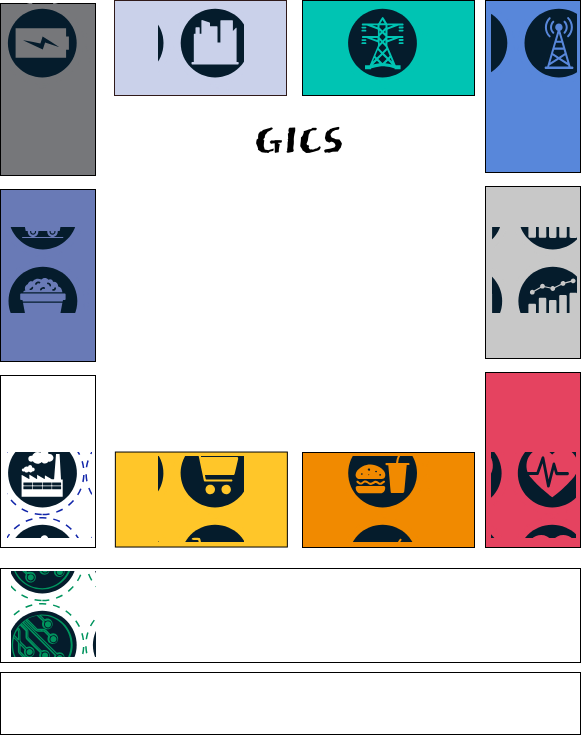
GICS Eleven sees sectors not only as a classification feature, but also as an editorial framework. Each of the eleven GICS sectors is conceived as an independent, topic-specific news portal - with a clear focus, consistent structure and recurring information patterns. The underlying concept is based on a simple idea: if companies, markets and risks are sector-specific, the information should also be sector-specific. GICS-Family & Friends (F&F) supplements GICS Eleven with trend and popularity topics for which topic-specific information requirements develop from the superordinate sector clusters. GICS F&F supplements GICS Eleven with a further 10 information portals, including those focusing on artificial intelligence, cyber security, crypto, cannabis and evergreens such as shopping, beauty, travel, entertainment and bedding/gambling/gaming.
How these portals are designed
- Clear thematic differentiation per sector
- Structured preparation of news, company information and market impulses
- Editorial separation of information, classification and visualization
- No implicit recommendations, no product focus
Who uses such portals
- Market observers with sectoral specialization
- Readers with a thematic rather than instrument-driven interest
- Journalists and research-related users
- Decision-makers, who want to understand developments in the context of an entire sector
The special feature
The focus is not on individual stocks, but on the economic environment in which companies operate. GICS Eleven thus creates consistent access to sector knowledge - structured, comparable and permanently usable.